
Towards the next phase
A summary of what's occurred, and some next steps

“Hitting send”
The hardest thing about writing, at least in my own case, is having to “hit send”. Within any piece it always feels like there is something that can be improved or re-worded, a better or more clear way to organize the thought process, or even, through writing itself, to come up with different and more interesting conclusions. It is an artistic process- like any, or at least most- which can invite us to keep working further if we are so inclined. But one needs to know when to finish, when it is time to move on and get on with the next thing; and indeed it is due time for me to wrap up the final conclusions in regards to this publication- and here I will outline briefly what was discovered and what the process was like, and what the next steps might look like.
But briefly, on the point about ‘process’: along with the uncertainty about ‘when something is finished’, another significant challenge is having to ‘be an artist on the side’, or to manage the balance, as many people do, in a social imaginary which struggles to see the value and work behind art- especially art which is concerned with a ‘creative metaphysical inquiry’. And so I have to, like many people, do what I need to do in order to eat and stay housed first, and then, if I have time, continue on with what is truly interesting, and in the process hope that too much wasn’t lost in the gaps in between.
This has been the case for over a year now since I started this publication, and in that time, I have moved to another country, completed my masters degree, started a new job, along with other noteworthy things.
But more relevant to this publication, this past year has been a time when I began to consider with more clarity some of the questions I’ve always been trying to ask, but never quite had the language for; it’s been a time when my frame of mind has been shifting towards a better understanding into ‘the nature of things’; but also, with the omni-present appreciation that ‘knowing’ and ‘understanding’ is not only about ‘concepts’ but more significantly about ‘being’; and in this past year these ‘conceptual’ and ‘more embodied’ ways of knowing have taken on new and interesting levels, and will hopefully lead to new and more interesting levels in the years to come.
The Transition in Being, Knowing, Valuing
Before getting into some details- which, I think, I will try and keep brief- I want to quickly show a recent diagram which might be relevant for this particular moment. As many believe, we are in a moment of ‘transformation’ or ‘transition’ (for better or worse), and one particular framing which might be useful is that this requires a transition in being, valuing, and knowing- on different scales and in different ways, but what is key is that it requires a change in what it means to know, in what it means to be, what it means to value, and likewise, what we know, what we are, and what we value.
The evolution of discourse is complex and difficult to consider, but this seems like an interesting way to wonder about its evolution: how can we better discuss and consider the transition of ‘being’ and ‘knowing’ and ‘valuing’ which (perhaps regrettably) is required at this time?
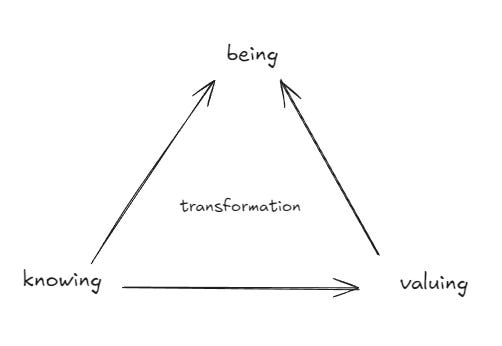
Within this evolving context, a new ‘epistemology’, a new ‘ontology’ and a new ‘understanding of value’ are all required (indeed, they are all already emerging, and are not necessarily ‘new’, and perhaps even something largely ‘rediscovered’) each of which rely and reference one another. Additionally, such an understanding probably has to take place in, and embody, a transition.
Considering these connections and framing is certainly one that stirs the mind; and it is not necessarily the case that one should look for a magical formula which can describe these connections, but just better ways to discuss and consider the entanglement of the three. And we might even say, considering this context, that to be and to value and to know is to perhaps to spur a transition, or at least engage with the notion of transition more genuinely.
But it is more or less with this in mind- the ‘transition in being and knowing and valuing’, both on an ‘individual’ and ‘socio-cultural’ scale- that I began this inquiry, even if I did not spell it out as such, and this particular context is one which I remain wondering about.
A Rough Overview of the First Phase
Like a few other publications that have appeared on Substack this past year or so, such as Magical flower of Winter and FEST (along with others I am sure I have not seen), this one here has been deliberately concerned with ‘inquiring about the whole’.
The most appropriate way to do that, from my own perspective, was to begin with the question: how do we manage the spiritual complexity1 of our lives? Then, I proposed a ‘psuedo answer’; namely, that this was through ‘social organization’, and touched on the inability of ‘science’ to provide an adequate understanding of what a ‘social organization’ (or social system) is. I framed this as the ‘embodiment problem’, and suggested that our current way of thinking makes it difficult, perhaps impossible, to speak about social systems with much clarity, particularly how they are embodied. Perhaps this ‘problem’ might be put to other ‘kinds of systems (or organizations)’ as well, specifically ‘complex adaptive systems’ more broadly, but here I was just considered the problem with ‘social systems’.
I then suggested that they are embodied ‘relationally’, and more particularly through ‘a network of state changes in a ‘common observational space’.
Later, I suggested that a way to consider this more clearly is through adopting the concept of ‘endosymbiosis’ to a social scale- suggesting that socio-cultural and psychic systems are ‘endosymbiotic’, and considered some challenges in developing this theory.
I then had a few more posts which tried to explore this endlessly interesting and difficult space of ‘psychic’ and ‘social’ systems, talking about ‘spells’, considering some ‘proto-theories for a science of the psychic field’, one of which included ‘psychic homeostasis’. The aim in these posts was to explore and consider the mysterious and illuminating life of ‘the mind’ or the ‘soul’ especially as it relates to ‘socio-cultural organization’. Indeed, it is hard to say anything at all about these relationships -other perhaps than that they exist- and these posts here served as exploratory, curious meanderings through these topics.
And perhaps it is worth mentioning here that much of this creative inquiry has occurred at this intersection: namely, how can one consider and speak about ‘psychic organizations’ and ‘social organizations’, and their entanglements, with more clarity?
Then, I visited the question that FEST and MFOW are both fundamentally concerned with, which is, more or less: what is the nature of reality? I then had four ‘metaphysical posts’ which outlined a grappling with these kinds of questions.
First, I suggested that the cosmos was ‘organizational’, meaning:
All things or processes in the cosmos are organizations of different kinds, which have, or perhaps fundamentally are, relationships with other organizations in the cosmos.
Second, I suggested that ‘cycles’ are an organizational form, and went on to suggest that:
If the Cosmos is the unfolding of various kinds of organization in relation to other organizations, it is equally, then, at least under this view, the unfolding of various kinds of cycles in relation to other kinds of cycles.
Third, I revisited the idea of ‘endosymbiosis’ and applied it to a more metaphysical scope, and suggested that:
If the Cosmos is the unfolding of organizations and their cycles, then global endosymbiosis suggests that this unfolding and relationality is fundamentally co-constitutive with and through other organizations and cycles; that the Cosmos is not merely full of separate organizations which collide and interact, but organizations which are, to varying degrees, entangled and co-constitutive and sensitive to other organizations.2
And fourth, that the Cosmos is one which tends towards processes of stability (perhaps not ‘in the end’, but generally), and so the view that was left after those four posts was something like this:
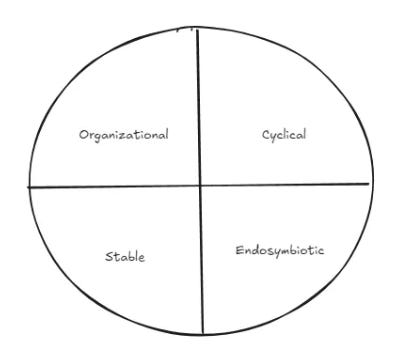
Namely, a ‘Cosmos’ which is composed of organizations, the basic structure of which is one of cycles, and that these organizations are both endosymbiotic and striving towards stability. As there are organizations in the Cosmos of different ‘kinds’, it becomes interesting and important to consider the many different events, cycles, entanglements, and ways of being stable are possible, both within and between organizations.
In this post I also suggested the ‘problem of organizational kind’ to put pressure on how to consider ‘different kinds’ or ‘different types’ of organizations and how to speak about them both usefully and gracefully.
And so it left the inquiry with diagram like this:
Finally, in the last post, I explored the possibility of grounding this view of the Cosmos on the notion of ‘state’, since ‘states’ of all kinds are, we might say, the undeniable form of being in the world at a given time (or moment), or are our way of being entangled in the World. And towards this end I also suggested the ‘interpretation problem’, which ‘puts pressure on the problem of how psychic or social or cultural states, or states that are not measurable in a physical substrate, require us to engage with and reflect on the vast and complex realities of human embodiment and how our own human embodiment can be understood as the method of interpretation for ‘scientific’ inquiry into psychic or even cultural states.’
I ended the inquiry on some final reflections:
What is a psychic state? What is a cultural, or social state? What is a psychic cycle, or event? Are different ‘organizational kinds’ categorized by the kinds of states that they enable? What is the relationship between an ‘event’ and a ‘state’? Is an ‘event’ a moment in time in which a new state is repeated, or a new state emerges? Perhaps: but like many questions in this inquiry, these will be bracketed and considered slowly, since most questions, at least ones that require a metaphysical mood, take a long time to consider, and it is often in the routines or movements of everyday life, when we are walking to the store or riding the train, or precisely when we are not thinking about them, where they are given the proper conditions to sort themselves out, however long that might take.
Next steps
Although now my mind has changed on a few things, this inquiry ‘served its purpose’ as a way to fundamentally grapple with looking into ‘the nature of reality’, in a way which more resembles an artistic method than a scientific one. Certainly, it is more difficult and less productive when one must ‘keep their life afloat’ which most artists, I imagine, have to struggle with. Indeed, an evolved civilization is one which allows artists to be artists without having to worry about food or housing, where ones basic needs are met and one can follow their own inclinations more thoroughly; and perhaps it should not come as a surprise that a social imaginary such as ours has little or no place for open and creative inquiries such as this one, partly because, as mentioned above, its grasp of being, valuing and knowing are the way that they are.
For anyone who might be interested, I will be starting a new Substack publication ‘Forma’ (there are currently no posts) which will follow the research for my PhD: ‘What are the institutional forms of type 1 and type 2 transdisciplinary research’? There, it will mostly be more of a journal to go over some the more experimental and creative things which a PhD itself does not include, and a way to grapple with some of these questions in a more open manner.
I also started a page to experiment a bit more with poetry here, and published my first poem the other day, and also have another publication dedicated to more ‘cultural commentary’ and things like that, here.
As for this particular page, a ‘second phase’ may or may not appear in the future, and mostly depends on the time and artistic inspiration that comes my way. But I am grateful for anyone who considered and or read about some of these questions as I grappled with them and lived through them, and served as a way for me to more clearly ‘attune’ to the World in a more ‘poetic’ way.
I don’t give an exact definition to what this is; just that the ‘complexity of the cosmos’ is at a phenomenological and socio-cultural level, which might be considered as being spiritual
I further suggested that we might see endosymbiosis as having a ‘strong’ and a ‘weak’ form.
Great! I'd love a session sometime following this up. But I'm in New Zealand for the coming two weeks... after that?
This interview with Michael Levin & Karl Friston about inFORMation and meaning points to pattern as key 🔑 at all ‘levels’.
.
https://open.substack.com/pub/curtjaimungal/p/the-missing-link-between-information?r=3le9sh&utm_campaign=post&utm_medium=web&showWelcomeOnShare=false