
Global (or complex) stability
Different ways of becoming stable, and the problem of organizational kind

Organizations, Cycles, and Endosymbiosis
The last three posts have all moved towards a metaphysical space, and in doing so aimed to get a better ‘grounding’ for some of the questions raised and bracketed within this inquiry, which mostly deal with and revolve around the nature of ‘organization(s)’, how they relate and entangle, and especially how this occurs in a sociocultural, or social, or psychic, or intelligible, or second order, kind of way. Some of the fundamental questions being considered here are: what are psychic, or social, or cultural, or intelligible organizations, and in what way does it make sense to speak about them?
The first suggestion was that:
All things or processes in the Cosmos are organizations of different kinds, which have, or perhaps fundamentally are, relationships with other organizations in the Cosmos.
And it was later suggested that organizations are fundamentally cyclical, meaning that organizations are fundamentally concerned with the unfolding of events which happen in a specific order, which leads to the second suggestion, which is that:
If the Cosmos is the unfolding of various kinds of organization in relation to other organizations, it is equally, then, at least under this view, the unfolding of various kinds of cycles in relation to other kinds of cycles.1
From here, the question of how organizations, or cycles, are entangled re-emerges as especially important, and the theory of ‘global (or complex) endosymbiosis’ was suggested as an attempt to consider how this entanglement might be imagined- even if more so in metaphor than in truth- so as to emphasize the dynamic, relational, ‘living’ and embedded nature of organizations with other organizations. And so it was thirdly suggested that:
If the Cosmos is the unfolding of organizations and their cycles, then global endosymbiosis suggests that this unfolding and relationality is fundamentally co-constitutive with and through other organizations and cycles; that the Cosmos is not merely full of separate organizations which collide and interact, but organizations which are, to varying degrees, entangled and co-constitutive and sensitive to other organizations.
Indeed, it is perhaps more metaphor than reality- since not all ‘organizations’ might be defined as ‘organisms’- but it is meant to point to and to emphasize the fundamental relationality and entanglement of organizations of different kinds, and how this relation is embedded and in many cases sensitive, dynamic, self-organizing, and lively.
Which leaves us with the following view: that the Cosmos (‘all that is the Cosmos’) is fundamentally organizational, or composed of organizations, which are, by their nature, cyclical, meaning that their structure is one which is built on the passing of events in a certain order. Further, these organizations, of which there are many different ‘kinds’ (ie. social, physical, psychic, cultural, or however they might be categorized) might be understood under the metaphor of ‘endosymbiosis’, meaning they are fundamentally entangled and ‘inside’ one another- fundamentally depending on one another for their organizational structure and operation, or fundamentally depending on one another for certain events to take place.
These broad metaphysical suggestions open up more questions than they answer (which is very much the point with such an inquiry), and the final concept which I hope to introduce here to this metaphysical space is ‘global (or complex) stability’, which aims to provide a lens for considering how organizations of different kinds are not only cyclical and entangled, but how organizations of different ‘kinds’, regardless of what they are- physical, biological, social, psychic- all have a similar aim, a similar way of being and becoming in the World- and that this aim is in discovering and maintaining a sense of stability.
Defining Stability (or Equilibrium)
Along with evolution, self-organization, self-maintenance, and a few other concepts which provide a deeply meaningful view of the World (or Cosmos) at nearly all levels (if not all ‘levels’) stability is one of those concepts which might allow us to bridge the many different kinds of ‘organizations’ in the Cosmos- it is a concept which might be applied to atoms, to ecosystems, or to civilization alike.
But doing so means, of course, that we have a clear definition of ‘stability’ which can traverse these organizations, and it’s not exactly obvious how straightforward such a definition is. Like elsewhere in the inquiry, I hope to rely here on more of an intuitive definition of ‘stability’, which might even be closer to ‘equilibrium’, which is generally defined as:
A state in which opposing forces or influences are balanced1
Or even as stable equilibrium, which is defined as:
A state in which a body tends to return to its original position after being disturbed2
The exact word, or definition, is not important, but we might say that equilibrium or stability generally refers to the capacity for an organization, of whatever kind, to individuate within an ecosystem of other organizations, and to maintain that stability. In other words, it refers to the capacity for an organization to self-organize and self-maintain.
Said more casually we might say that stability resonates with the idea that ‘everything has its place’ in the World, that there is a ‘universal balance’ to things in the World, and so on.
Stability seems to be what all organizations desire; it seems to be the process through which all organizations adapt to and operate within an ecosystem, or goal space, or state space, or whatever is, at the time, the most appropriate way to conceptualize ‘environment’.
We might say that stability, as a certain kind of state, or recurrence of states, is a sort of attractor which organizations can embody within and through their cyclical form.
It has something to with the capacity for cycles to endure in organized (or even meaningful) ways, with an organization ‘keeping its form’, and also, at the same time, remaining dynamic and self-organizing.
But we might broadly say that stability arises through the process of self-organization, or individuation, and that is continued through self-maintenance, and that this rough definition, for now, seems to be the most appropriate one. 3
Whatever the case, along with our three metaphysical concepts mentioned already- organization, cycle, and global endosymbiosis, none of which are neatly defined, other than perhaps ‘cycle’- stability, or equilibrium, enters the picture as a way to imagine a ‘harmony’ or ‘balance’, especially as a harmony or balance of different kinds of organizations in the Cosmos. And like with the other concepts raised here, it is more of a broad stroke than a painstaking and detailed one: the concept is meant to be a simple and general one to further guide this inquiry.
Different Ways of Becoming Stable
In a World of complex and emerging organizations, it is difficult to have an adequate framework for understanding the aim and the character of different kinds of organizations, how they are entangled, and how to speak about them meaningfully and accurately. Keeping this in mind, the aim of introducing the term ‘global stability’4 here is a more intuitive attempt to suggest that different ‘kinds’ of organizations all have a similar aim, even if that ‘stability’ might look different depending on the kind of organization, and the way in which stability happens.
As such, global stability as used here refers to a blanket term to consider and point to the many different kinds of stability which appear in various kinds of organizations- like, for example, homeostasis as it relates to ‘biological organizations’ or ‘metastability’ as used by Simondon5 - to try and better understand what organizations have in common, as well as how they might be different.
Indeed, the process in which an ‘atom’ and a ‘civilization’ become ‘stable’ vary in their level of complexity, but the concept seems to be intuitively similar across the two: ‘stability’ is something which organizations move towards- it is, perhaps, their goal, their attractor, their modus operandi.6
As such, stability, or equilibrium, might look different or require different events for different kinds of organizations, but nonetheless everyone can have an intuitive sense of what stability means. Whatever the different ‘kind’ or method of stability, they all have a similar character, a process through which an organization ‘self-organizes’ and ‘self-maintains’.
But that also raises an interesting question: what are the ways that different organizations become stable, and could this be a way of considering how they should be ‘categorized’?7 8
As a question which continuously reappears in this inquiry, we might even go ahead and consider this as the problem of organizational kind. Which is to say, the problem of organizational kind here refers to the challenge of how to delineate, or categorize, or classify different kinds of organizations (especially ‘social’ or ‘psychic’ or ‘intelligible’ ones). What distinguishes one ‘kind’, or type, of organization from another’?
However this might be later explored, we at least for the time being might say that global or complex stability roughly deals with the many ways in which organizations become ‘stable’, or reach an ‘equilibrium’ in the Cosmos’, and we might point out that there are many different ways of being ‘stable’, of many different ways that an equilibrium is possible, but that all variations of stability are generally similar in their aim. Moreover, that this aim can be broadly deals with the ways that different kinds of organizations self organize and self maintain, or the way that organizations enable and participate in events, and structure cycles out of those events. 9
In trying to get a bit closer to a definition here, then, we might point out three characteristics of global, or complex, stability:
An umbrella term for considering stability as it happens in different ‘kinds’ of organizations
Looking more specifically at the ways organizations of different ‘kinds’ become stable
Thirdly, which was not discussed much here in this post- although in many ways is a mix of the two previous points- is in looking at different kinds of organizations, or different ways of becoming stable, and how they co-produce a more emergent stability, or stability on different ‘levels’ (ie. the stability of the ecosystem)
Global stability, then, is a conceptualization of stability which is not only meant to point to different ways of becoming stable, which might occur in various organizations, but also how these different ways of becoming stable rely on one another, even if their ‘stability’ occurs in a different sort of character, and how different kinds of organization also work to produce more ‘emergent’ stability.10
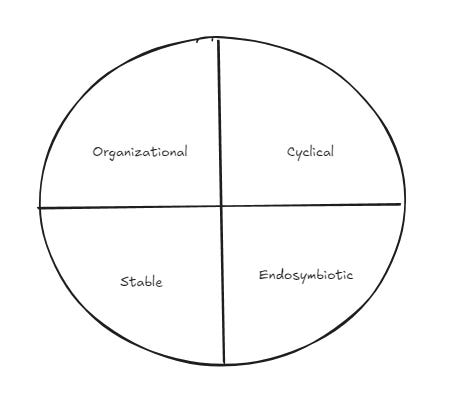
An Organizational, Cyclical, Endosymbiotic, Stabilizing Cosmos
As this is a creative metaphysical inquiry mostly dealing with the nature of ‘organization’, but equally and more importantly an inquiry which is more open to whatever seems worth exploring, this picture drawn here in these last four posts could and might change, but for the time being, serves as a way of providing a foundation to move the inquiry forward.
However this may or may not be addressed in the coming posts, the picture we are left with is the following one: namely, a ‘Cosmos’ which is composed of organizations, the basic structure of which is one of cycles, and that these organizations are both endosymbiotic and striving towards stability. As there are organizations in the Cosmos of different ‘kinds’, it becomes interesting and important to consider the many different events, cycles, entanglements, and ways of being stable are possible, both within and between organizations.
And as the metaphysical turn begins to wrap up, more poignant questions have emerged in these last few posts to be further bracketed, such as:
What is a ‘psychic’ or ‘social’ or ‘intelligible’ or ‘cultural’ event?
What is a ‘psychic’ or ‘social’ or ‘intelligible’ or ‘cultural’ cycle? How do they 'entangle’?
How does a human being or a human relationship, or a culture, or a civilization, become ‘stable’? What does that mean and require?
What are the ways that different organizations become stable, and could this be a way of considering how they should be ‘categorized’?
Indeed, we might say that one potential way of doing this is in considering ‘different kinds of events’, or ‘different kinds of ‘cycles’, or, as mentioned, in looking more closely at ‘different ways or methods of becoming stable’. At the moment, these are the kinds of question which are at the forefront of this inquiry.
Oxford dictionary
Oxford dictionary
I am not sure most people would agree, but I would suggest ‘self-organization’ as something that all ‘organizations’ do- including things like atoms
In its normal usage, the term ‘Global stability’ itself is sometimes defined as being concerned with ‘the whole state space’, or with the notion that ‘regardless of initial conditions, an equilibrium is reached’.
Metastability refers to a kind of stability where ‘a minimal quantity of energy or information can trigger a brusque alteration of equilibrium, and lead to the invention of new structures and hence to a new ‘metastable state’. Simondon seems to suggest that it is a different kind of stability, but nonetheless still might be referred to as a ‘kind’ of stability.
And we might even go as far as to suggest that different organizations might be defined through the way in which they become stable, their metabolic process which is able to (potentially) discover and maintain a sense of stability.
We might also ask: how are different organizations embodied? In asking this question, we can point out that ‘embodiment’ is not necessarily exclusive to the human body, the spiritual or psychic unfolding present in the human experience, but instead ‘embodiment’ more generally can be understood as the process in which an organization 'embodies’ itself. Indeed, one can apply the concept of embodiment to any kind of organization: we might say that an atom embodies itself, we might say that a civilization embodies itself, and the question ‘how’ is one that certainly should be raised.
Although this is a question which, like many others, will be bracketed, we might suggest that the possibility of stability for both is entangled, or endosymbiotic with one another: namely, that the ways in which a psychic organization become stable (the psychic unfolding present in human embodiment) and the the ways in which a cultural, or social organization become stable (however we might define such an organization), rely on one another.
We might also say that to embody these cycles and aim towards some kind of stability is to be an organization.
Another post for the future: perhaps ‘second order stability’ is a way to rephrase metastability- and these might be conceptualized as the two primary ‘kinds’ of stability.